
Clinical Efficacy in Cognitive Impairment
Efficacy and safety of Cerebrolysin® in cognitive impairment has been assessed in randomized, double-blind, placebo-controlled trials and in one meta-analysis.
Key clinical benefits of Cerebrolysin® in cognitive impairment are:
Key clinical benefits of Cerebrolysin® in cognitive impairment are:
Cerebrolysin® is safe and well tolerated in both.
Remarkable cognitive improvements
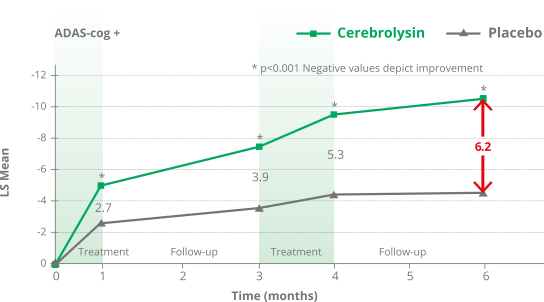
The largest clinical trial to date was performed by Guekht et al. 2011 . Primary study endpoint was ADAS-cog+ from baseline at week 24. Patients treated with Cerebrolysin® improved by –10.62 points in the ADAS-cog+ and by -4.4 in the placebo group, resulting in a significant difference of -6.2 points at week 24 (p<0.0001) in favor of Cerebrolysin®.
Prolong active and independent life
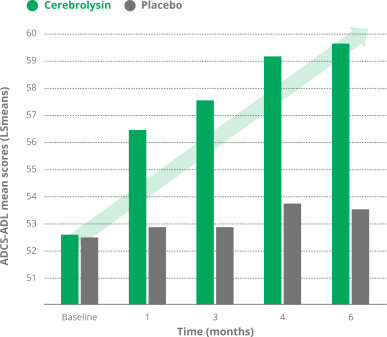
Activities of daily living (ADL) such as any self-care duties (e.g. feeding, bathing, dressing, grooming), are an important measure for patients independence effected by dementia. Guekht et al. 2011 showed significant superiority of Cerebrolysin® in ADCS-ADL score (Alzheimers’s Disease Cooperative Study – Activities of Daliy Living), while placebo demonstrated unchanged situation. Even within the follow-up-period Cerebrolysin® group shows consistent enhancements in the ADCS-ADL.
Higher quality of life
The impact of neurotrophic intervention on global functions is as pronounced and long-lasting as its impact on cognitive functions.
Guekht et al. 2011 evaluated CIBIC+ (Clinicians Interview-based Impression of Change with Caregiver Input scale), which is a comprehensive global measure of changes in cognition, function and behavior based on separate interviews with patients and caregivers. The test rates patients on a 7 point ordinal scale.
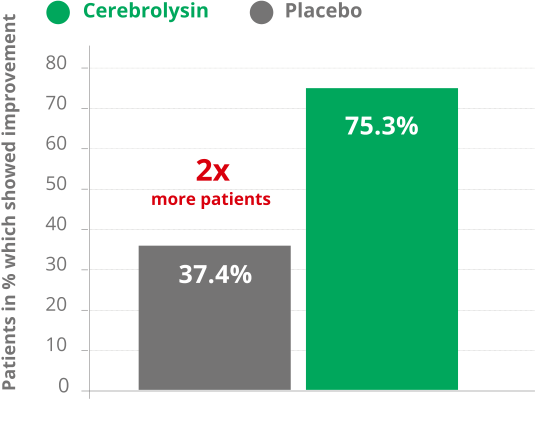
The CIBIC+ Assessment showed a significant shift towards improvement in the Cerebrolysin® group when compared to placebo. The majority of patients in the Cerebrolysin® group showed improvement (75.3%, vs 37.4% in the placebo group). In the placebo group, the majority of patients remained unchanged (45.2% vs 17.1% in the Cerebrolysin® group).
Guekht et al. 2011 evaluated CIBIC+ (Clinicians Interview-based Impression of Change with Caregiver Input scale), which is a comprehensive global measure of changes in cognition, function and behavior based on separate interviews with patients and caregivers. The test rates patients on a 7 point ordinal scale.
The CIBIC+ Assessment showed a significant shift towards improvement in the Cerebrolysin® group when compared to placebo. The majority of patients in the Cerebrolysin® group showed improvement (75.3%, vs 37.4% in the placebo group). In the placebo group, the majority of patients remained unchanged (45.2% vs 17.1% in the Cerebrolysin® group).
Prevention of behavioral disorders
Patients with Alzheimer’s disease develop behavioral problems in the later stages of the disease, which place a very large burden on their families and caregivers.
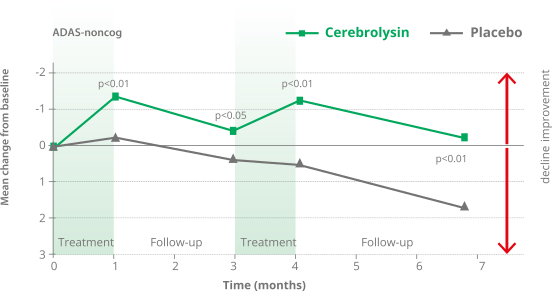
The ADAS-noncog (Alzheimer’s Disease Assessment Scale – non-Cognitive Section) is measuring behavior in patients with Alzheimer’s disease. Ruether et al. 2002 showed significant improvements of behavior in AD patients treated with Cerebrolysin®, while placebo showed decline.
The ADAS-noncog (Alzheimer’s Disease Assessment Scale – non-Cognitive Section) is measuring behavior in patients with Alzheimer’s disease. Ruether et al. 2002 showed significant improvements of behavior in AD patients treated with Cerebrolysin®, while placebo showed decline.
Double-click this headline to edit the text.


Guekht, Alla B., et al. Cerebrolysin® in vascular dementia: improvement of clinical outcome in a randomized, double-blind, placebo-controlled multicenter trial. Journal of Stroke and Cerebrovascular Diseases, 2011, 20. Jg., nr. 4, S. 310-318.
Ruether, E., et al. Sustained improvement of cognition and global function in patients with moderately severe Alzheimer’s disease: a double-blind, placebo-controlled study with the neurotrophic agent Cerebrolysin®. In: Ageing and Dementia Current and future Concepts. Springer, Vienna, 2002. S. 265-275.
Ruether, E., et al. Sustained improvement of cognition and global function in patients with moderately severe Alzheimer’s disease: a double-blind, placebo-controlled study with the neurotrophic agent Cerebrolysin®. In: Ageing and Dementia Current and future Concepts. Springer, Vienna, 2002. S. 265-275.